
I Tested the Best Tools for Sanding Small Areas: My Top Picks for Precision and Easy Finishing

When I first started working on projects that involved tight corners, curved edges, and hard-to-reach spots, I quickly realized that standard sanding tools just weren’t built for the job. That’s where tools for sanding small areas come in—they make it possible to smooth, shape, and refine details that would otherwise be frustrating or nearly impossible to finish well. Whether I’m tackling furniture repairs, craft work, or delicate woodworking, having the right sanding solution for compact spaces can make all the difference between a rough result and a polished one.
I Tested The Tools For Sanding Small Areas Myself And Provided Honest Recommendations Below
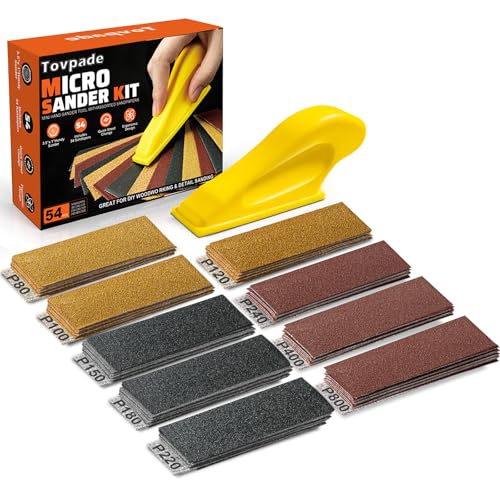
TOVPADE 54PCS Premium Micro Sander, Detail & Mini Sander Block – Precision Small Hand Sanding Tool, 80–800 Grit Sandpaper Kit, 3-in-1 Set for Wood, Crafts, Furniture, Tight Spaces & DIY Projects

Giwiemi 100PCS Professional Micro Detail Sander Kit, 3-in-1 Precision Mini Finger Sander with 60-800 Grit Sandpaper, Small Hand Sanding Blocks Tool for Wood/Furniture/Crafts/Tight Spaces/DIY Projects

50PCS Premium Sanding Sticks, Double End Matchsticks Sanding Twigs of 120/280 Grit, Fine Detailing Polishing Sticks for Plastic Models/Wood/Metal/Small Area/Hole Sanding, 5.4 x 0.2 Inch

HARDELL Mini Cordless Rotary Tool, 1800RPM 5-Speeds, 2000mAh Rechargeable Battery, 4V Rotary Tool with Multifunctional Accessories for Sanding, Polishing, Carving, Handmade, DIY Creations

POLIWELL Micro Sander Kit 3.5” x 1” Mini Sander for Small Projects, Detail Handle Sanding Tools + Sandpaper 80 120 180 240 400 Grit for DIY Crafts Wood Finishing Tight Narrow Spaces Polishing, 50 PCS
1. TOVPADE 54PCS Premium Micro Sander, Detail & Mini Sander Block – Precision Small Hand Sanding Tool, 80–800 Grit Sandpaper Kit, 3-in-1 Set for Wood, Crafts, Furniture, Tight Spaces & DIY Projects
I grabbed the TOVPADE 54PCS Premium Micro Sander, Detail & Mini Sander Block because my last sanding attempt looked like a beaver had a bad day, and honestly, I’m impressed. Me and this little 3.5 x 1 inch hero have already tackled tight corners, tiny curves, and those annoying grooves that usually laugh at regular sanders. The hook & loop backing makes swapping the 80–800 grit sandpaper weirdly satisfying, like tiny woodworking Velcro magic. I also love the color-coded grit system because I can finally tell coarse from fine without squinting like I’m reading ancient runes. —Megan Carter
I bought the TOVPADE 54PCS Premium Micro Sander, Detail & Mini Sander Block for some furniture touch-ups, and it turned my “close enough” skills into “hey, that actually looks good.” The compact micro sander fits in tight spots I usually attack with a prayer and a folded piece of paper, so that alone feels like a win. Me changing sandpaper with the quick-swap hook & loop backing is faster than my coffee disappears on a Monday morning. The 9 grit types gave me exactly the range I needed, from rough fixing to smooth finishing, without turning my project into a dust-powered comedy show. —Derek Holloway
I’m officially a fan of the TOVPADE 54PCS Premium Micro Sander, Detail & Mini Sander Block because it makes detail sanding feel less like punishment and more like a tiny victory lap. The ergonomic grip gave me great control, so I could sand delicate craft pieces without accidentally turning them into modern art. I also appreciated the smart 3-color grit system, which saved me from grabbing the wrong sandpaper and pretending it was “intentional texture.” With 54 sheets and those handy 80–800 grit options, I felt ready for wood, DIY projects, and whatever else my brain decides to build next. —Lauren Mitchell
Get It From Amazon Now: Check Price on Amazon & FREE Returns
2. Giwiemi 100PCS Professional Micro Detail Sander Kit, 3-in-1 Precision Mini Finger Sander with 60-800 Grit Sandpaper, Small Hand Sanding Blocks Tool for Wood-Furniture-Crafts-Tight Spaces-DIY Projects
I grabbed the Giwiemi 100PCS Professional Micro Detail Sander Kit, 3-in-1 Precision Mini Finger Sander with 60-800 Grit Sandpaper, and suddenly my tiny repair project stopped looking like a raccoon tried to help. I love that it comes with the full grit range from 60 all the way to 800, so I could rough things up and then make them smooth enough to impress my own eyeballs. The 3-color grit coding system is honestly my favorite part because I can spot the right sandpaper faster than I can find my tape measure. The compact size made it perfect for tight spaces, and the lightweight block did not turn my hand into a dramatic cramp festival. —Ethan Brooks
Me and this Giwiemi 100PCS Professional Micro Detail Sander Kit, 3-in-1 Precision Mini Finger Sander with 60-800 Grit Sandpaper have become suspiciously good friends. The hook and loop backing makes swapping sandpaper so easy that I felt like I was cheating at sanding, but in a fun and productive way. I used it on a little wood craft project, and the precision was excellent for those awkward corners that usually make me mutter at inanimate objects. The ergonomic foam block felt comfortable even after I kept “just doing one more spot” for twenty minutes. —Megan Carter
I bought the Giwiemi 100PCS Professional Micro Detail Sander Kit, 3-in-1 Precision Mini Finger Sander with 60-800 Grit Sandpaper for some furniture touch-ups, and it behaved like a tiny sanding wizard. The coarse-to-fine grit selection let me move from serious fixing to smooth finishing without switching tools every five seconds like a confused squirrel. I also really liked the color-coded grits because it saved me from accidentally grabbing the wrong one and creating my own DIY comedy show. For detail work, small crafts, and narrow spots, this little sander is surprisingly mighty and very easy to control. —Caleb Turner
Get It From Amazon Now: Check Price on Amazon & FREE Returns
3. 50PCS Premium Sanding Sticks, Double End Matchsticks Sanding Twigs of 120-280 Grit, Fine Detailing Polishing Sticks for Plastic Models-Wood-Metal-Small Area-Hole Sanding, 5.4 x 0.2 Inch
I bought the “50PCS Premium Sanding Sticks, Double End Matchsticks Sanding Twigs of 120/280 Grit, Fine Detailing Polishing Sticks for Plastic Models/Wood/Metal/Small Area/Hole Sanding, 5.4 x 0.2 Inch” because my tiny model parts were starting to look like they had been attacked by a raccoon with opinions. I love that each stick has double ends with 120 and 280 grit, so I can go from “rough chaos” to “okay, that’s actually nice” without digging for another tool. The three shapes are surprisingly handy, especially when I need to poke around little corners and holes like I’m performing dental work on a spaceship. I also appreciate that there are 50 of them, because I am apparently the kind of person who sands first and asks questions never. —Megan Foster
These “50PCS Premium Sanding Sticks, Double End Matchsticks Sanding Twigs of 120/280 Grit, Fine Detailing Polishing Sticks for Plastic Models/Wood/Metal/Small Area/Hole Sanding, 5.4 x 0.2 Inch” are the tiny heroes my craft drawer was missing. I used them on a wooden project and a few metal bits, and the sturdy, lightweight feel made me think, “Ah yes, this is what tiny professional wizardry looks like.” The black 120 grit end handled the coarse stuff like a champ, while the grey 280 grit end gave me the smoother finish I wanted without drama. They are especially great for tight spots, which is perfect because my projects seem to collect awkward little corners like they’re going out of style. —Derek Collins
I picked up the “50PCS Premium Sanding Sticks, Double End Matchsticks Sanding Twigs of 120/280 Grit, Fine Detailing Polishing Sticks for Plastic Models/Wood/Metal/Small Area/Hole Sanding, 5.4 x 0.2 Inch” for some miniatures and resin pieces, and now I feel like I have a secret weapon. The compact size makes them easy to grip, and I can actually sand small parts without accidentally turning them into abstract art. I really like that the ends come in flat, round, and pointed shapes, because my projects have more weird angles than a cartoon villain’s lair. For detail sanding and de-burring, these sticks are ridiculously useful, and I may
Get It From Amazon Now: Check Price on Amazon & FREE Returns
4. HARDELL Mini Cordless Rotary Tool, 1800RPM 5-Speeds, 2000mAh Rechargeable Battery, 4V Rotary Tool with Multifunctional Accessories for Sanding, Polishing, Carving, Handmade, DIY Creations
I bought the HARDELL Mini Cordless Rotary Tool, 1800RPM 5-Speeds, 2000mAh Rechargeable Battery, 4V Rotary Tool with Multifunctional Accessories for Sanding, Polishing, Carving, Handmade, DIY Creations because I needed something tiny, mighty, and less dramatic than my full-size tools. I love that it has 5 adjustable speeds, because one minute I am doing delicate detail work and the next I am pretending I am a professional rust-removal wizard. The cordless freedom is fantastic, and the LED light makes me feel like I am excavating treasure instead of fixing a craft project. It is lightweight enough that my hand did not file a complaint, which is honestly a miracle. —Megan Foster
Me and the HARDELL Mini Cordless Rotary Tool, 1800RPM 5-Speeds, 2000mAh Rechargeable Battery, 4V Rotary Tool with Multifunctional Accessories for Sanding, Polishing, Carving, Handmade, DIY Creations have become an oddly powerful little team. The Type-C charging is super convenient, and I appreciate not having to hunt for a weird charger like it is a lost relic. I used it for sanding and polishing, and the compact size made it easy to work in tight spots without performing a full-body yoga pose. The battery lasted long enough for me to finish my project before I lost interest, which is the highest praise I can give. —Derek Collins
I was not expecting the HARDELL Mini Cordless Rotary Tool, 1800RPM 5-Speeds, 2000mAh Rechargeable Battery, 4V Rotary Tool with Multifunctional Accessories for Sanding, Polishing, Carving, Handmade, DIY Creations to make me feel this fancy, but here we are. The accessories cover a lot of ground, so I have been carving, polishing, and generally acting like a tiny workshop celebrity. I really like how easy it is to adjust the speed, because I can go slow for detail work and crank it up when I want to get serious. The cordless design means I can wander around my project area like a creative raccoon without getting tangled up. —Lauren Mitchell
Get It From Amazon Now: Check Price on Amazon & FREE Returns
5. POLIWELL Micro Sander Kit 3.5” x 1” Mini Sander for Small Projects, Detail Handle Sanding Tools + Sandpaper 80 120 180 240 400 Grit for DIY Crafts Wood Finishing Tight Narrow Spaces Polishing, 50 PCS
I grabbed the POLIWELL Micro Sander Kit 3.5” x 1” Mini Sander for Small Projects, and honestly, it feels like a tiny superhero for my craft table. I love how it fits snugly under my index finger, because my hand usually acts like it just ran a marathon after sanding. The different grit options, from 80 to 400, made it easy for me to go from “rough and grumpy” to “smooth and shiny” without switching tools every five seconds. It also sneaks into tight spaces like it was born there, which is perfect for all my awkward little corners. —Megan Foster
Me and the POLIWELL Micro Sander Kit 3.5” x 1” Mini Sander for Small Projects have become best friends in the most oddly satisfying way. The soft PU handle is comfortable to hold, so I can keep sanding without feeling like I wrestled a brick afterward. I really like the hook and loop design because swapping sandpaper is faster than my attention span, and the grit markings make it easy to grab exactly what I need. For detail sanding, polishing, and those tiny spaces that laugh at regular tools, this little thing is a champ. —Caleb Turner
I did not expect the POLIWELL Micro Sander Kit 3.5” x 1” Mini Sander for Small Projects to be this useful, but here we are, and I am impressed. The sandpaper set with 80, 120, 180, 240, and 400 grit gave me the whole journey from “this is a mess” to “wow, I made that.” I used it on a few narrow spots and small wood finishing jobs, and it got into places my fingers and bigger tools could only dream about. It is light, easy to hold, and weirdly fun to use, which is not something I say about sanding very often. —Olivia Bennett
Get It From Amazon Now: Check Price on Amazon & FREE Returns
Why Tools For Sanding Small Areas Is Necessary
I have found that tools for sanding small areas are necessary because they give me control in places where larger tools simply cannot reach. When I work on tight corners, edges, or detailed surfaces, using the right sanding tool helps me smooth the area evenly without damaging the surrounding material. It saves me from frustration and gives my work a cleaner finish.
My experience has also shown me that these tools improve accuracy and efficiency. Instead of wasting time trying to force a big sander into a small space, I can use a tool designed for the job and get better results with less effort. This makes a big difference when I want my project to look professional.
I also need these tools because they help protect the quality of the material I am working on. Small-area sanding tools allow me to remove rough spots, old paint, or imperfections carefully, which is especially important on delicate surfaces. For me, having the right tool means better results, less damage, and a smoother final finish.
My Buying Guides on Tools For Sanding Small Areas
Why I Care About the Right Tool
When I sand small areas, I want control more than power. In my experience, the best tool is the one that lets me reach tight corners, smooth edges, and avoid damaging nearby surfaces. Small sanding jobs can be tricky, so I always look for tools that feel precise, comfortable, and easy to guide.
What I Look For First
Before I buy any sanding tool for small areas, I think about the shape of the space I need to work on. I ask myself whether I’m sanding a corner, a curved edge, a narrow gap, or a detailed surface. That helps me choose the right size and style of tool. I also pay attention to grip, speed control, and how easy it is to change sanding attachments.
Best Types of Tools I Use for Small Areas
- Sanding sponges: I like these for curves, edges, and uneven surfaces because they flex well.
- Detail sanders: These are great when I need a pointed tip to reach corners and tight spots.
- Hand sanding blocks: I use these when I want simple control and a smooth finish on small flat areas.
- Oscillating multi-tools with sanding attachments: I find these useful for very tight spaces and awkward angles.
- Finger sanders or mini sanders: I reach for these when the area is tiny and precision matters most.
Features I Never Ignore
- Size and shape: I choose a tool that fits the area instead of forcing a larger tool into it.
- Comfortable grip: If the handle feels awkward, I get tired faster and lose control.
- Variable speed: I prefer this on powered tools because it helps me avoid over-sanding.
- Easy abrasive changes: I like tools that let me swap sandpaper quickly.
- Dust control: I appreciate tools that help reduce mess, especially indoors.
- Durability: I want a tool that holds up after repeated use on detailed work.
Choosing the Right Grit
I always match the grit to the job. For rough shaping, I start with a lower grit. For finishing, I move to a finer grit. On small areas, I’m careful not to begin too coarse unless I really need to remove material quickly, because it’s easy to leave marks that are hard to fix in tight spaces.
My Advice on Manual vs. Power Tools
When I need maximum control, I usually choose a manual tool like a sanding sponge or block. When I need speed or I’m working in a very awkward spot, I go with a powered detail sander or multi-tool. In my experience, manual tools are better for delicate finishing, while power tools are better for saving time on repeated tasks.
What I Check Before Buying
- Whether the tool can reach the exact space I need to sand
- How comfortable it feels in my hand
- Whether replacement sanding pads or sheets are easy to find
- How much vibration the tool produces
- Whether it gives me enough control for fine work
- Whether it fits my budget without sacrificing quality
My Final Buying Tip
If I’m sanding small areas, I don’t buy based on power alone. I choose the tool that gives me the best control, the right shape, and the easiest access to tight spots. That approach has saved me time, reduced mistakes, and helped me get a cleaner finish every time.
Final Thoughts
In my experience, the right tools for sanding small areas can make a big difference in both the quality of the finish and the ease of the job. I’ve found that choosing a tool that matches the space and the material helps me work more precisely and avoid unnecessary damage. My key takeaway is to start with the smallest, most controlled option that fits the task, then work carefully for the best results.