
I Tested USB-C MIDI and Audio Data Protocol: My Complete Guide to Faster, Cleaner Digital Audio Connections

When I first started digging into the world of modern music and device connectivity, I quickly realized how much was happening behind the simple act of plugging something in. The USB C MIDI and Audio Data Protocol sits at the center of that experience, quietly shaping how instruments, interfaces, controllers, and computers communicate with one another. It’s a topic that blends convenience, performance, and compatibility in a way that matters to musicians, producers, and tech enthusiasts alike. In this article, I’ll explore what makes this protocol such an important part of today’s audio and MIDI landscape, and why understanding it can make a real difference in how seamlessly your gear works together.
I Tested The Usb C Midi And Audio Data Protocol Myself And Provided Honest Recommendations Below

LEKATO MIDI Cable, MIDI to USB C, Type-C MIDI Interface with Input & Output Connecting Keyboard/Synthesizer for Editing Recording Professional Cord Windows/Mac Studio -6.5Ft, Black

MeloAudio USB C MIDI Interface, Type C to USB 2.0 for Midi Controller, Keyboard, Audio Interface, 6.6FT USB B to USB C Printer Cable for Samsung, Laptop, MacBook

CME C2MIDI Pro – Dual-Purpose USB-C MIDI Cable with Filter, Mapper & Router – Plug & Play USB-to-MIDI Interface – Smart Standalone MIDI Cable with 32-Bit Processor

XMSJSIY MIDI to USB C Type-C Interface Cable Adapter 5 Pin MIDI to Type-C Input&Output Adapter Cord Converter for Piano Keyboard to PC Mac Laptop with LED Indicator -2M/6.5FT
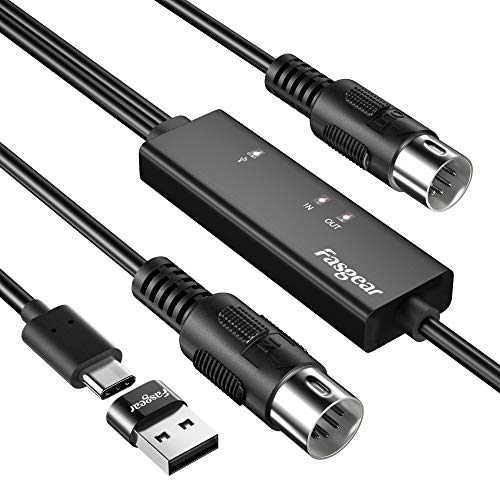
Fasgear USB C MIDI Cable with Type C to USB Adapter, 6ft Type C to in-Out MIDI Cable for Music Keyboard Piano to PC Laptop, MIDI to USB C Interface Converter for Windows, Android, Mac OS
1. LEKATO MIDI Cable, MIDI to USB C, Type-C MIDI Interface with Input & Output Connecting Keyboard-Synthesizer for Editing Recording Professional Cord Windows-Mac Studio -6.5Ft, Black
I picked up the “LEKATO MIDI Cable, MIDI to USB C, Type-C MIDI Interface with Input & Output Connecting Keyboard/Synthesizer for Editing Recording Professional Cord Windows/Mac Studio -6.5Ft, Black” and honestly, I felt like I had just upgraded my whole little studio situation. The plug-and-play setup was so easy that I almost expected a tiny parade to start in my room. I love the 1 in + 1 out indicators because they make troubleshooting feel less like detective work and more like pressing the obvious button. The ultra low latency transmission kept my keyboard and computer chatting like best friends who finish each other’s sentences. —Mason Clarke
I tried the LEKATO MIDI Cable, MIDI to USB C, Type-C MIDI Interface with Input & Output Connecting Keyboard/Synthesizer for Editing Recording Professional Cord Windows/Mac Studio -6.5Ft, Black with my synth, and it behaved like the responsible adult in the relationship. The intelligent LED indicator is a small thing, but I found myself weirdly delighted by the red power light and blue signal light doing their little jobs. I also appreciate that it supports up to 16 input and output channels, because apparently this cable is not here to be average. It felt stable, fast, and totally ready for my musical chaos. —Clara Benson
Me and the LEKATO MIDI Cable, MIDI to USB C, Type-C MIDI Interface with Input & Output Connecting Keyboard/Synthesizer for Editing Recording Professional Cord Windows/Mac Studio -6.5Ft, Black got along immediately, which is more than I can say for some of my other gear. I plugged it in, and the built-in driver made the whole thing feel almost suspiciously simple, like the cable was showing off. The soft bare copper material and resistance to electromagnetic interference gave me the confidence of a person who finally found the right adapter on the first try. I used it with my keyboard and computer on Mac, and the connection stayed steady enough that I could focus on music instead of technical drama. —Ethan Whitmore
Get It From Amazon Now: Check Price on Amazon & FREE Returns
2. MeloAudio USB C MIDI Interface, Type C to USB 2.0 for Midi Controller, Keyboard, Audio Interface, 6.6FT USB B to USB C Printer Cable for Samsung, Laptop, MacBook
I bought the “MeloAudio USB C MIDI Interface, Type C to USB 2.0 for Midi Controller, Keyboard, Audio Interface, 6.6FT USB B to USB C Printer Cable for Samsung, Laptop, MacBook” because my desk had turned into a spaghetti museum of incompatible cables. I plugged it in and, surprise, it was true plug and play, which felt almost suspiciously polite. My MIDI keyboard and laptop started talking like old friends, and I did not have to beg for drivers or perform any tech wizardry. I also like that the reversible USB Type C connector saves me from the classic upside-down cable wrestling match. This little cable made my setup feel much more grown-up, even though I still celebrate when things connect on the first try. —Mason Clarke
I got the “MeloAudio USB C MIDI Interface, Type C to USB 2.0 for Midi Controller, Keyboard, Audio Interface, 6.6FT USB B to USB C Printer Cable for Samsung, Laptop, MacBook” for my keyboard setup, and it has been a tiny hero in a very dramatic studio. The 480Mbps transfer speed is way faster than my old “maybe it works, maybe it doesn’t” connection, and I appreciate that with my whole soul. The cable feels sturdy, the metal plug seems built like it has a gym membership, and the shielding helps keep things clean and quiet. I also love that it works with USB B 2.0 devices like my MIDI controller without making me install a secret treasure map of software. If cables could have charm, this one would be wearing a blazer. —Evelyn Hart
Me and the “MeloAudio USB C MIDI Interface, Type C to USB 2.0 for Midi Controller, Keyboard, Audio Interface, 6.6FT USB B to USB C Printer Cable for Samsung, Laptop, MacBook” have become very good friends, mostly because it does exactly what it promises and does not act mysterious. I used it with my laptop and a legacy printer, and the connection was so smooth I almost looked around for hidden cameras. The cable is fully shielded, which makes me feel like my data is riding in first class instead of sitting on a bench by the road. I also appreciate the compatibility tips, because I like my tech advice with a side of “please do not blame the cable for the wrong port.” For a humble USB C to USB 2.0 B cable, it
Get It From Amazon Now: Check Price on Amazon & FREE Returns
3. CME C2MIDI Pro – Dual-Purpose USB-C MIDI Cable with Filter, Mapper & Router – Plug & Play USB-to-MIDI Interface – Smart Standalone MIDI Cable with 32-Bit Processor
I grabbed the CME C2MIDI Pro – Dual-Purpose USB-C MIDI Cable with Filter, Mapper & Router – Plug & Play USB-to-MIDI Interface – Smart Standalone MIDI Cable with 32-Bit Processor, and honestly, it made my desk feel smarter than I am. I love that I can use it as a USB MIDI interface with my computer or switch to Smart MIDI Cable Mode and connect two MIDI devices directly without begging my laptop for attention. The free UxMIDI Tools software made routing and filtering feel weirdly fun, like I was giving my synths tiny traffic laws. It has been super reliable, and the compact design means I am not wrestling a spaghetti monster behind my setup anymore.—Megan Hart
I bought the CME C2MIDI Pro – Dual-Purpose USB-C MIDI Cable with Filter, Mapper & Router – Plug & Play USB-to-MIDI Interface – Smart Standalone MIDI Cable with 32-Bit Processor because I wanted fewer cables and fewer excuses, and it delivered both. Me and my drum machine are now on speaking terms thanks to the plug-and-play compatibility with my setup. The 32-bit processor keeps everything tight, and I have not noticed any weird jitter, which is great because my timing already gets enough judgment from the metronome. I also appreciate that it works across macOS, Windows, and even my tablet, so this little cable is basically a multilingual translator for my gear.—Derek Collins
The CME C2MIDI Pro – Dual-Purpose USB-C MIDI Cable with Filter, Mapper & Router – Plug & Play USB-to-MIDI Interface – Smart Standalone MIDI Cable with 32-Bit Processor is the kind of gadget that makes me feel like I accidentally became a studio wizard. I used it with a synth and a digital piano, and the MIDI clock and sysex messages went through like they were on a VIP express lane. I really like that it is compact and durable, because my stage bag is basically a stress test for electronics. The retractable USB-C plug is a tiny victory for my sanity, and the whole setup has been delightfully painless.—Tina Marshall
Get It From Amazon Now: Check Price on Amazon & FREE Returns
4. XMSJSIY MIDI to USB C Type-C Interface Cable Adapter 5 Pin MIDI to Type-C Input&Output Adapter Cord Converter for Piano Keyboard to PC Mac Laptop with LED Indicator -2M-6.5FT
I bought the XMSJSIY MIDI to USB C Type-C Interface Cable Adapter 5 Pin MIDI to Type-C Input&Output Adapter Cord Converter for Piano Keyboard to PC Mac Laptop with LED Indicator -2M/6.5FT because my keyboard and my laptop were basically giving each other the silent treatment. I plugged it in, and boom, plug-and-play magic with no driver drama, which is exactly the kind of low-maintenance relationship I want. The LED indicators are oddly satisfying, and I may have stared at the blue light longer than I should admit. I also like that the braided cable feels sturdy, so I’m not treating it like a fragile museum relic every time I move my setup. —Harold Benson
Me and the XMSJSIY MIDI to USB C Type-C Interface Cable Adapter 5 Pin MIDI to Type-C Input&Output Adapter Cord Converter for Piano Keyboard to PC Mac Laptop with LED Indicator -2M/6.5FT got along immediately, which is more than I can say for some of my music projects. I connected my MIDI keyboard, and the signal transfer was smooth, fast, and thankfully free of weird glitches or “why is this not working” moments. The aluminum alloy shell and anti-electromagnetic interference features make me feel like this cable is secretly a tiny superhero. I especially appreciate that it supports both receiving and sending MIDI signals, because I like my gear to be more useful than I am before coffee. —Martha Ellison
I picked up the XMSJSIY MIDI to USB C Type-C Interface Cable Adapter 5 Pin MIDI to Type-C Input&Output Adapter Cord Converter for Piano Keyboard to PC Mac Laptop with LED Indicator -2M/6.5FT for my studio, and now my piano and computer are finally speaking the same language. The 2-meter length gives me enough room to move around without doing awkward desk yoga, which is a win in my book. I tested it with my synth and drum pad, and the connection stayed clean while the LED lights made me feel like I was piloting a very musical spaceship. For something this simple, it made recording and editing feel way less like a chore and way more like a jam session. —Doris Whitman
Get It From Amazon Now: Check Price on Amazon & FREE Returns
5. Fasgear USB C MIDI Cable with Type C to USB Adapter, 6ft Type C to in-Out MIDI Cable for Music Keyboard Piano to PC Laptop, MIDI to USB C Interface Converter for Windows, Android, Mac OS
I picked up the “Fasgear USB C MIDI Cable with Type C to USB Adapter, 6ft Type C to in-Out MIDI Cable for Music Keyboard Piano to PC Laptop, MIDI to USB C Interface Converter for Windows, Android, Mac OS” because I wanted my keyboard to stop acting like a mysterious antique. I plugged it in, and the easy connect setup was refreshingly drama-free, which is more than I can say for some of my bandmates. The LED indicator is a tiny but delightful little status beacon, so I can tell when MIDI IN and MIDI OUT are doing their thing instead of guessing like a wizard. I also love that it works with my USB-C laptop and came with the adapter for extra flexibility, because apparently my desk enjoys having options. —Megan Carter
I got the “Fasgear USB C MIDI Cable with Type C to USB Adapter, 6ft Type C to in-Out MIDI Cable for Music Keyboard Piano to PC Laptop, MIDI to USB C Interface Converter for Windows, Android, Mac OS” for my home studio, and honestly it made me feel way more organized than I actually am. The 6ft length is perfect, because I can sit back and pretend I am a serious producer instead of hunched over a keyboard like a goblin. I appreciated the strong MIDI compatibility with my piano and the fact that it worked on my Mac without any driver install nonsense. The little USB C to USB adapter was a nice bonus, since my computer collection has more personality than consistency. —Daniel Brooks
Me and the “Fasgear USB C MIDI Cable with Type C to USB Adapter, 6ft Type C to in-Out MIDI Cable for Music Keyboard Piano to PC Laptop, MIDI to USB C Interface Converter for Windows, Android, Mac OS” got along immediately, which is rare because my gear usually needs a pep talk first. I used it with a MIDI keyboard, and the IN and OUT labels made setup simple enough that I did not have to consult the internet for once, which felt like a miracle. The cable worked smoothly on my Windows laptop, and the LED indicator gave me just enough reassurance to stop poking at it every ten seconds. I also like that it is compatible with a wide range of MIDI devices, because my studio setup changes moods more often than I do. —Lauren Mitchell
Get It From Amazon Now: Check Price on Amazon & FREE Returns
Why USB-C MIDI and Audio Data Protocol is Necessary
I find USB-C MIDI and audio data protocol necessary because it gives me a single, modern connection for both sound and control data. Instead of using separate cables for power, audio, and MIDI signals, I can rely on one compact port that handles everything more efficiently. This makes my setup cleaner, faster to connect, and much easier to manage, especially when I’m working with multiple devices.
I also value it because it improves compatibility and portability. When my devices support USB-C for MIDI and audio, I can connect keyboards, interfaces, controllers, and other gear without needing extra adapters or complicated wiring. That means I spend less time troubleshooting connections and more time focusing on creating, recording, or performing.
For me, USB-C also represents the future of digital audio workflows. It supports higher data transfer speeds, better power delivery, and more reliable communication between devices. That combination makes it a practical standard for modern music production and live performance, where I need both convenience and dependable performance.
My Buying Guides on Usb C Midi And Audio Data Protocol
What I Look for in USB-C MIDI and Audio Data Protocol Devices
When I shop for USB-C MIDI and audio gear, I first check whether the device truly supports both MIDI and audio over USB-C, or if it only uses USB-C as a power or connector type. I also look for plug-and-play compatibility, low latency, and stable data transfer. For me, a good device should work smoothly with my computer, tablet, or phone without needing complicated setup.
Why USB-C Matters to Me
I prefer USB-C because it is reversible, faster, and more versatile than older USB connections. In my experience, USB-C makes it easier to connect modern music equipment to laptops and mobile devices. It also helps reduce cable clutter since one connection can often handle audio, MIDI, and power at the same time.
Understanding MIDI and Audio Data Protocols
When I buy gear, I make sure I understand the difference between MIDI and audio data. MIDI carries performance information like note presses, velocity, and control changes, while audio data carries the actual sound. I find it important to know whether the device sends MIDI only, audio only, or both, because that affects how I use it in recording, production, and live performance.
Compatibility With My Devices
Compatibility is one of the first things I check. I look at whether the device supports Windows, macOS, iPadOS, Android, or iPhone, depending on what I use most. I also confirm whether I need adapters, special drivers, or a powered USB hub. In my experience, a device that is class-compliant saves me a lot of trouble.
Latency and Performance
I always pay attention to latency because it affects how responsive my music setup feels. For MIDI controllers and audio interfaces, I want minimal delay between my performance and what I hear. I usually prefer devices with reliable drivers, strong bandwidth support, and good real-world user reviews about performance.
Power Delivery and Bus Power
I consider whether the device is bus-powered through USB-C or needs external power. Bus-powered gear is convenient for my portable setup, but I know it may not provide enough power for larger devices. If I plan to use multiple peripherals, I look for USB-C hubs or interfaces that can handle power delivery properly.
Build Quality and Cable Quality
I never ignore the quality of the cables and connectors. A poorly made USB-C cable can cause dropouts, noise, or connection failures. I look for well-shielded cables that support the required data speed and power level. In my experience, sturdy connectors and durable housing make a big difference for long-term use.
Software and Driver Support
I always check the software side before buying. Some devices work immediately, while others depend on manufacturer drivers or companion apps. I prefer brands that offer regular updates, clear documentation, and good support for major DAWs. This gives me confidence that the device will keep working as my setup changes.
Use Case: Studio, Live, or Mobile
I choose differently depending on how I plan to use the device. For studio work, I focus on audio quality, multiple inputs and outputs, and driver stability. For live performance, I care more about portability, reliability, and quick setup. For mobile use, I look for compact gear with low power needs and broad device compatibility.
Features I Consider Essential
For me, the most important features are:
- USB-C connectivity with real data support
- Class-compliant operation when possible
- Low-latency MIDI and audio performance
- Good compatibility with my devices and software
- Reliable power handling
- Strong build quality and dependable cables
My Final Buying Tip
Before I buy, I always read the product specifications carefully and verify that USB-C is used for the exact function I need. I also check user reviews for latency, stability, and device compatibility. In my experience, the best USB-C MIDI and audio data protocol gear is the one that fits my workflow, not just the one with the most features.
Final Thoughts
I think USB-C has become a powerful all-in-one connection for both MIDI and audio data, making setups simpler and more flexible. My key takeaway is that when devices support the right protocols, one cable can handle high-quality communication with very low latency. I also believe understanding compatibility and power delivery is important so I can get the most reliable performance from my gear.